Shelf-Ready Brand Systems

FMCG Branding

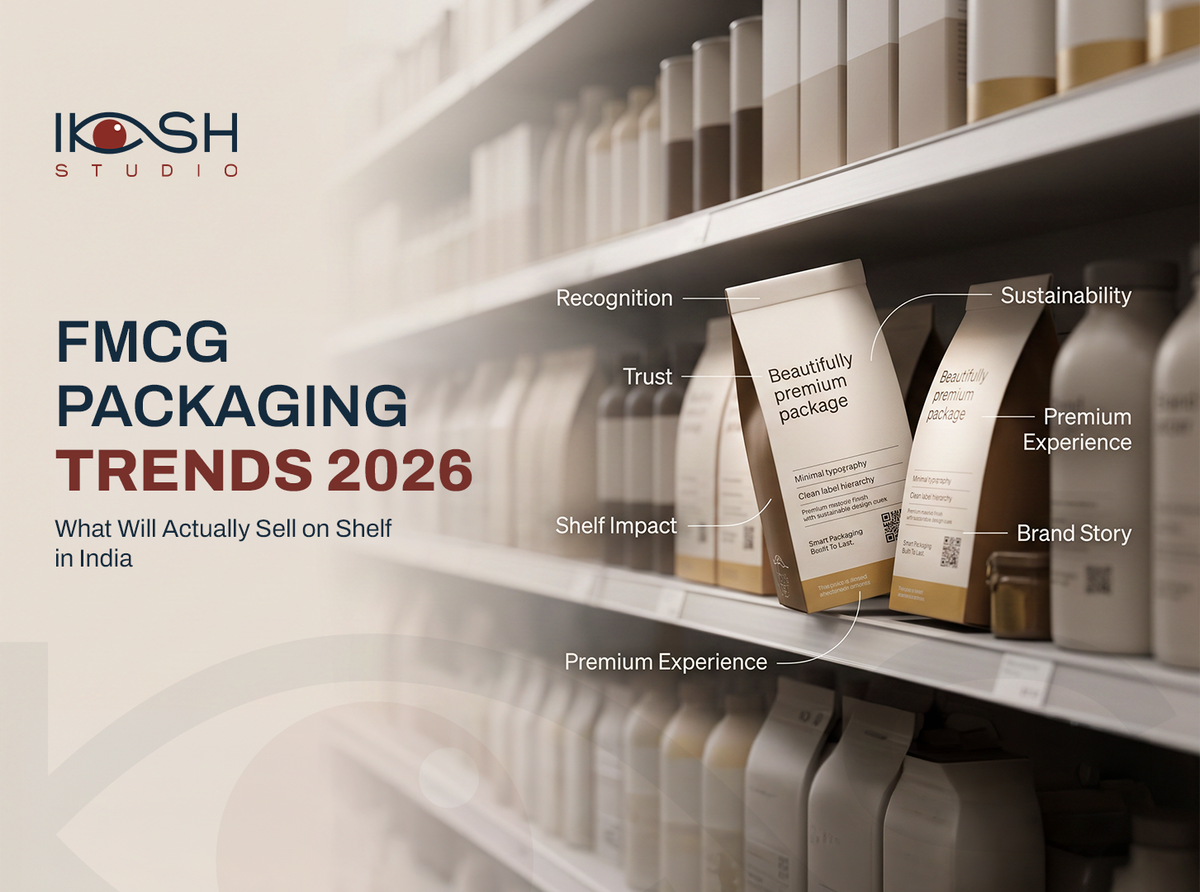
FMCG brands win or lose in three seconds flat, at the shelf or on a phone screen scrolling through a quick-commerce app. We build brand systems that hold up under that pressure, from naming to pack to reorder.

Key takeaways
  • FMCG branding is decided in seconds, so pack design has to work harder than any other brand touchpoint.
  • Distribution reality (GT, MT, quick commerce) should shape identity decisions, not just aesthetic taste.
  • Compliance details like FSSAI marks and MRP placement need to be designed in, not bolted on later.
  • A distinctive shelf code protects a brand once bigger competitors start copying its category cues.
Industry overview

What the fmcg branding category looks like today.

Current market

India's FMCG sector runs on volume and velocity, with thousands of SKUs fighting for the same shelf metre in kirana stores, modern trade and now ten-minute delivery apps. Margins are thin, distribution is fragmented, and a new entrant needs to look established from day one to earn trial.

Customer behaviour

Shoppers decide fast, often in under five seconds at physical shelves, and even faster while thumb-scrolling a delivery app grid where only the pack image and price are visible. Trust is built through familiarity, so brands lean on colour blocking and category codes buyers already recognise.

Brand expectations

Buyers expect clear claims (FSSAI mark, MRP, quantity), honest ingredient callouts, and packaging that doesn't feel like it's hiding something. Value-for-money perception matters as much as the product itself, especially once a brand pushes into tier-2 and tier-3 towns.

Growth opportunities

Quick commerce has opened a second front for challenger brands that can't afford modern trade listing fees. A sharp identity and pack design lets a small FMCG player look credible next to legacy names, both online and on a crowded general trade shelf.

Challenges we solve

  • 01Shelf clutter — Dozens of near-identical SKUs sit side by side, so a new brand's pack has to earn a second look without shouting louder than everyone else.
  • 02Thin differentiation budgets — Most FMCG challengers can't afford mass media, so the pack itself has to do the job a TV ad would have done for a legacy brand.
  • 03Multi-channel consistency — The same SKU needs to work as a thumbnail on a delivery app, a physical pack on a dusty shelf, and a bulk case for distributors.
  • 04Category code confusion — Founders often chase originality and end up designing packaging shoppers don't recognise as belonging to the category at all.
  • 05Regional expansion pressure — A brand built for metro modern trade often looks foreign or overpriced once it enters tier-2 general trade, hurting sell-through.
  • 06Frequent SKU extensions — New variants and pack sizes get added quickly, and without a system in place, the shelf turns messy within a year of launch.

Our solutions

  • Category mapping first — We audit the shelf and the app grid before designing anything, so we know exactly which codes to keep and which to break.
  • Naming built for recall — Names are tested for how they sound at a kirana counter and how they read as a tiny app thumbnail, not just on a mood board.
  • Pack architecture, not one-off design — We build a system that scales across variants and pack sizes so a five-SKU brand can grow to fifty without a redesign.
  • Compliance-aware layouts — FSSAI, MRP and quantity information is planned into the layout grid from the first concept, avoiding last-minute label panic.
  • Distribution-tested visuals — Every design is checked against a real shelf photo and a phone screen mockup before final sign-off.
Why branding matters

Strategic branding is a business decision, not decoration.

An FMCG product with no brand system behind it is a commodity, and commodities compete only on price. That's a losing game against players with bigger factories and longer credit lines. A distinct identity gives a smaller brand pricing room and a reason to be chosen twice. Distributors also judge a brand by how it looks before they judge it by margin. A pack that looks professional gets easier shelf placement and better display terms, because the retailer believes it will move. Over time, consistent branding compounds. A shopper who recognises your colour and logo from a quick-commerce app is more likely to pick you up again at a kirana store three states away, which is exactly how regional FMCG brands turn into national ones.

Market context

The landscape shaping fmcg branding today.

Market landscape

India's FMCG market is still deeply general-trade driven outside metros, even as quick commerce grows fast in cities. This means a brand's packaging has to perform in two very different environments at once: a well-lit warehouse fulfilling a ten-minute order, and a small shop with uneven lighting and limited shelf space. Regional and challenger brands are gaining ground against legacy multinational players by moving faster on flavours, formats and pack sizes. But speed without a coherent identity system just creates a messy portfolio, which is where many founder-led FMCG companies get stuck around their third or fourth product launch.

Customer expectations

  • Clear MRP and quantity visible at a glance
  • FSSAI license number and compliance marks in place
  • Ingredients and claims that don't feel exaggerated
  • Consistent look across pack sizes and variants
  • Packaging that survives transit and humidity
  • Pricing that matches the pack's perceived value

Digital transformation

Quick commerce has changed FMCG discovery more than any other shift in the last decade. A brand's first impression is now often a 200-pixel thumbnail on Blinkit or Instamart rather than a shelf walk, which means pack design has to be legible and distinctive at a tiny size, not just striking in a photoshoot. D2C websites and marketplace listings add another layer, where the same brand needs product photography, category pages and content that build trust without a shopkeeper vouching for it. We design FMCG identities knowing they'll live across all three environments from the start.

Why Iksh Studio

A sector-aware partner for fmcg branding.

  1. 01
    Shelf-first design thinking

    We test every concept against real retail conditions, not just a clean studio render, so what looks good on screen also works in a shop.

  2. 02
    Category fluency

    We understand the visual codes of Indian FMCG categories, from spices to snacks to personal care, and know when to follow them and when to break them.

  3. 03
    Scalable systems

    Our identity work is built to support SKU growth over years, not just the five products a founder is launching with today.

  4. 04
    Compliance built in

    We plan for FSSAI and labelling requirements from the first draft, avoiding costly redesigns closer to launch.

Our approach

Our industry approach.

Research first, design second. The route we take through a fmcg branding engagement, stage by stage.

  1. 01

    Industry Research

    We study category dynamics, distribution channels and price bands specific to your FMCG segment before any design work begins.

  2. 02

    Competitor Analysis

    We map shelf sets and app listings of direct and adjacent competitors to find the visual white space available to you.

  3. 03

    Consumer Understanding

    We study who buys the category, how often, and what makes them switch brands or stay loyal to one.

  4. 04

    Brand Strategy

    We define positioning, tone and price perception so every future design decision has a clear reference point.

  5. 05

    Identity Design

    We design logo, colour system and typography built to read clearly at both shelf distance and thumbnail size.

  6. 06

    Packaging

    We design pack architecture across your SKU range, balancing distinctiveness with category recognisability.

  7. 07

    Digital Experience

    We adapt the identity for D2C storefronts, marketplace listings and quick-commerce app tiles.

  8. 08

    Marketing Assets

    We build launch creatives for trade, social and in-store visibility including standees and shelf talkers.

  9. 09

    Launch

    We support the go-to-market rollout across trade and digital channels, checking real-world execution against the design system.

Typical deliverables
Brand name and taglineLogo and identity systemPrimary and secondary packaging designSKU architecture guidelinesBrand guideline documentShelf and display collateralD2C and marketplace listing kitTrade marketing materialsLaunch communication assets
Insight

Why most FMCG rebrands fail at the shelf, not the studio

A pack can win every internal review and still lose in a real store. Here's why that gap exists and how to close it.

Most FMCG rebrand reviews happen on a laptop screen in a conference room, lit well, zoomed in, next to nothing else. That's the opposite of how the pack will actually be seen: at arm's length, under fluorescent tube light, sandwiched between five competitors doing the same category cues.

The fix isn't more design polish, it's testing conditions. We print rough mockups and physically place them in a mixed shelf set before finalising anything, because distinctiveness only matters if it survives real competition, not a clean deck.

The brands that get this right treat packaging as a retail tool first and a design object second. That mindset shift, more than any colour choice, is what separates FMCG rebrands that move volume from ones that just look nice.

A pack that only wins in the boardroom hasn't been tested where it actually needs to win.

Investment guide

Typical investment ranges.

Brand Identity
Starting from ₹50,000

Strategy, logo, and core visual system.

Packaging Design
Starting from ₹35,000

Per SKU. Structural and graphic design.

Website
Starting from ₹60,000

Design, build, SEO, and CMS.

Campaign
Custom quote

Scoped to channels, deliverables, and duration.

Every project is tailored to your business goals, scope, and timeline. Ranges below are starting points, not fixed prices.

Investment

Packages for fmcg branding

Transparent ranges. Every engagement is scoped to your goals, timeline, and audience.

Launch

₹2,00,000 – ₹4,00,000

Single-SKU or early-stage FMCG brand.

  • Brand Positioning
  • Logo & Identity
  • 1 Product Packaging
  • Basic Guidelines
  • Launch Social Kit
Most chosen

Growth

₹5,00,000 – ₹12,00,000

Brands scaling to a full product range.

  • Full Brand Strategy
  • Packaging System (up to 5 SKUs)
  • Website Design
  • Photography Direction
  • Retail POSM

Signature

₹15,00,000 – ₹50,00,000+

End-to-end FMCG brand partnership.

  • Brand Architecture
  • Multi-SKU System
  • E-commerce Experience
  • Video Production
  • Launch Campaign
  • Ongoing Brand Consulting
FAQ

Questions, answered.

See all

Engagement model

Retainer or project

Sprint, phased, or ongoing

Typical timeline

4 – 12 weeks

Depending on scope & stage

Starting investment

From ₹3.5L

Indicative · scoped to fit

Engagement

Investment for fmcg branding brands.

Indicative ranges · Custom scopes available · GST extra (India).

Book Discovery Call
Related content

Keep reading, keep exploring.

Ready when you are

Ready to build an FMCG brand that earns shelf space

Let's talk about your category, your channels, and what your pack needs to do that it currently isn't.